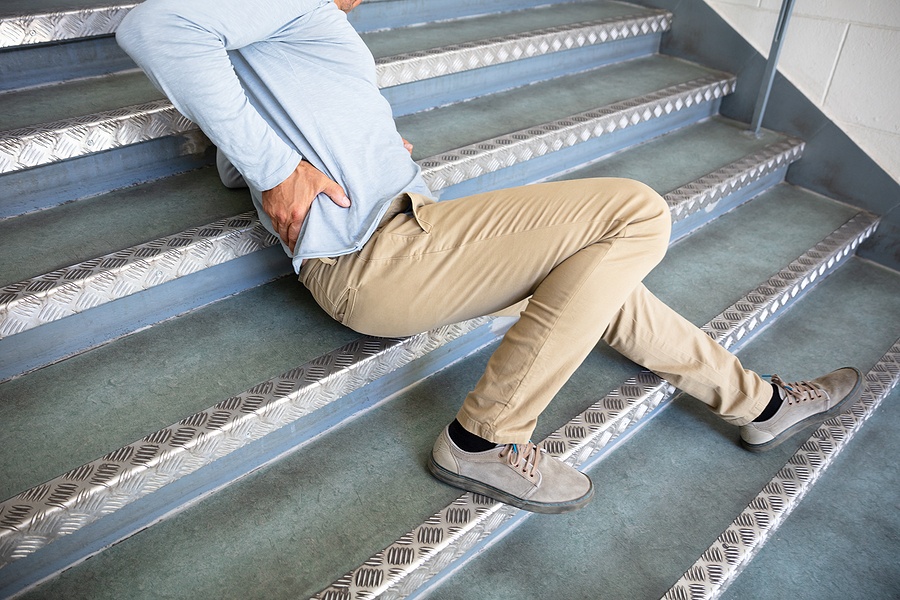
Slip, trip, and fall. You’ve heard it, but what does it mean? If you’re injured at work, while shopping, or at a friend’s apartment complex, you’re told to find a slip, trip, and fall accident attorney.
A slip, trip, and fall accident is generally a catch-all phrase used to cover three very distinct situations. California courts, lawyers, and safety experts all know there are clear differences between the three when it comes to liability and a legal defense.
Slip, Trip, and Fall Accidents: The Mechanics, Hazards, and Legal Standards
Understanding Slip Accidents
Slip accidents occur when there’s a loss of traction between a shoe and walking surface. It happens when you step on wet flooring without warning signs. You slip while walking on freshly waxed floors. You slip on a puddle that’s covering outdoor tiles in a business’s entryway.
Typically, your foot slips forward, and your center of gravity shifts backward, leading you to fall back and hit the ground with your lower back, tailbone, spinal column, or back of your head.
Common injuries from slip accidents include:
- Concussions and traumatic brain injuries (TBIs)
- Spinal disc injuries
- Tailbone fractures
Understanding Trip Accidents
Trip accidents happen when your foot or lower leg collides with a sudden elevation change or something sticking up or out from another surface. It happens when you walk into a building, and the walkway is cracked and raised, a piece of carpeting in a dimly lit hallway is curled, or an extension cord is left in a walkway.
During a trip accident, your foot or leg suddenly stops moving or is restricted, so your upper body moves forward while your leg or foot is held back. Momentum keeps your body moving forward, so you end up falling forward. Common injuries include:
- Broken teeth
- Facial trauma
- Shattered kneecaps
- Shoulder dislocations
- Wrist or arm fractures
Understanding Fall Accidents
Fall accidents are divided into two categories: Same-Level or Elevation Falls. With both, there’s a drop and impact as your body hits the ground.
Same-level falls occur when you lose your balance and fall. The fall is often the result of a slip or trip.
Elevation falls occur when you fall from a height or elevated position to the ground below. They include falls where:
- A guest falls over a low railing on a balcony.
- A railing gives way on a pier, and the person falls to the beach or rocks below.
- A worker falls from a ladder or roof.
The injuries can be severe and even fatal. Shattered bones, TBIs, and internal injuries are all possible.
Many California elevated fall lawsuits result from safety regulation or building code violations. The proof that Cal/OSHA regulations were violated is often all it takes to prove negligence.
The Legalities of Property Owner Liability
When someone slips, trips, or falls in your business or on your property, liability has to be determined. Under California Civil Code Section 1714(a), it’s crucial to understand the differences when establishing liability. You need to prove causation and overcome any arguments the defense team may bring up that show negligence of a “trivial defect.”
Civil Code Section 1714(a) and the Duty of Care
California Civil Code § 1714(a) states that an individual is responsible for both their intentional acts and any injury that occurs due to their intentional acts or actions with property management.
In the landmark case Rowland v. Christian (1968), Nancy Christian reported her cracked faucet knob to her apartment management. She later invited a friend into her apartment, and he got a severe injury using her faucet and sued her for the injury. California courts had to determine if the invitee, renter, or property owner was at fault.
She’d told her landlord about the issue, but the landlord hadn’t done anything in two weeks. Her guest said she’d failed to tell him of the cracked knob. She believed that had he actually looked, he would have seen it and avoided cutting his hand. The judgment was for the defendant.
Factual Elements (CACI No. 1000 & 1001)
Under CACI No. 1001, property owners must maintain their property, which means repairing, replacing, or warning others of any issues that could cause harm or injury to another person. To establish grounds for a slip, trip, and fall liability claim, the plaintiff must prove:
- The defendant owned, leased, lived in, or controlled the property.
- The defendant was negligent when using or maintaining the property.
- The plaintiff was injured or harmed.
- The defendant’s negligence was the primary reason for that harm or injury.
CACI No. 1001 builds upon this by considering:
- The property’s location.
- The likelihood of someone entering the property in the same way the plaintiff did.
- The chances of harm, and the possible severity of harm.
- The odds of the property owner knowing of that chance of harm and its severity.
- How hard it is to protect against that harm.
- How much influence the defendant had to stop harm or injury from happening.
The “Trivial Defect” Defense
The Trivial Defect Doctrine frequently comes into play during a California slip, trip, or fall case. Under this California law, a public entity or property owner is not liable for damages from a defect on a walkway that meets guidelines for being “trivial.” Generally, trivial means that the elevation shift is less than 0.75 inch.
There are exceptions to this rule, however. If the lighting is poor, objects block visibility, or debris hides the defect, it can be deemed non-trivial.
Other Standards That Impact Claims
Comparative negligence standards are also applied in slip-and-fall cases. There are different scenarios when these standards come into play.
- Government Claims Act: The trip or fall occurred on government-owned property, so the claim falls under Government Code § 810 et seq., which has a six-month statute of limitations and requires you to prove the property was dangerous, the potential injury or harm was foreseeable, and the office had more than enough time to correct it.
- Open and Obvious: The hazard was clearly visible, and there’s no way you could have missed it.
- Partial Fault: You’re looking at a phone when you trip on a sidewalk. You’re also at fault for not paying attention to your surroundings.
When to Contact a Personal Injury Attorney
California’s legal landscape regarding slips, trips, and falls is complex. You need a clear legal strategy and undeniable evidence. It’s a legal area where Shegerian Conniff’s legal team excels.
Don’t try to navigate the legal complexities on your own. Schedule a free legal consultation with our office and get the answers you need on whether you have a valid slip, trip, and fall complaint and what your next steps need to be to prove your claim.